
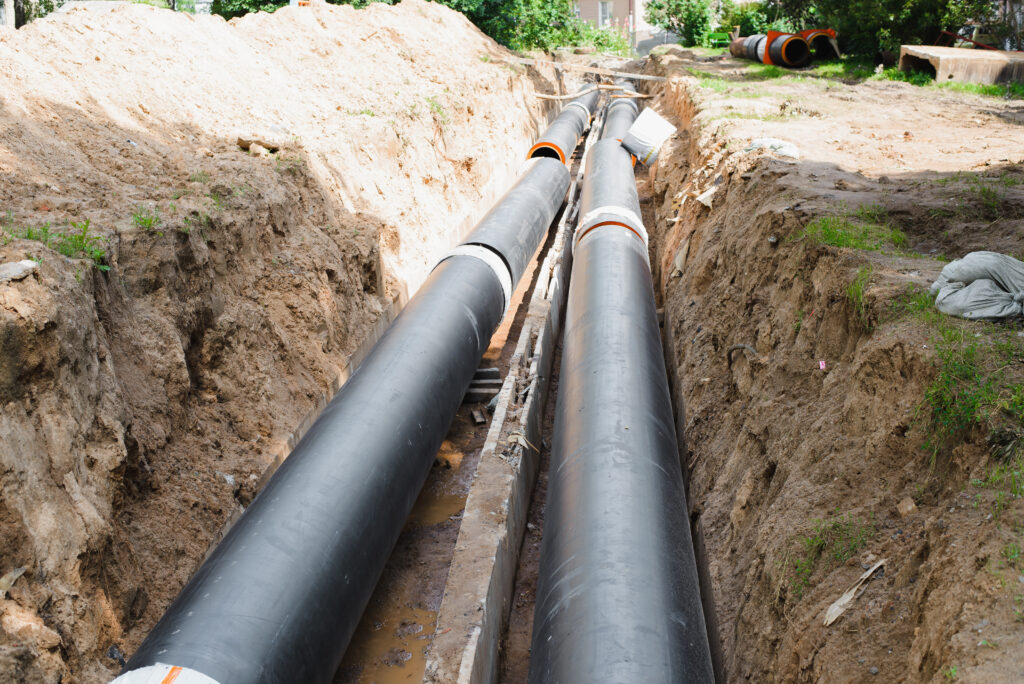
HDPE can be well suited to flood irrigation systems because it combines corrosion resistance, flexibility, relatively low weight and compatibility with welded pipe networks. These characteristics can be useful on Australian farms, where water needs to move over long distances, and infrastructure may be exposed to changing ground and weather conditions.
Material selection still needs to reflect the actual project. Pipe diameter, pressure class, installation method and operating conditions remain important, but understanding the properties of HDPE helps explain why it is widely considered for agricultural water transfer.
HDPE Does Not Corrode Like Metal Pipe
Corrosion resistance is one of the main reasons HDPE is used for agricultural water infrastructure.
Irrigation pipelines can spend years in contact with water, soil and outdoor environments. Metallic systems may require corrosion management depending on the material and conditions, while polyethylene itself does not rust.
This can be particularly relevant where pipelines are buried or run across large farming properties, as sections may be difficult to access once the network is operating.
Resistance to corrosion does not remove the need for correct installation or inspection. It does, however, reduce one potential mechanism of deterioration when the material is appropriate for the water being conveyed.
For flood irrigation, where large volumes may repeatedly pass through the same network, this property can support longer-term infrastructure planning.
Flexibility Can Help Across Variable Farm Terrain
HDPE has a degree of flexibility that can be useful where agricultural pipelines follow changing ground conditions.
Australian farms are rarely completely uniform. A line may cross paddocks, drainage areas, access tracks and changes in elevation before reaching an irrigation bay.
A flexible piping material can accommodate gradual changes in alignment without requiring a fitting at every minor change in direction.
This does not mean the pipe can simply be bent around any obstacle. Minimum bend radius, installation method and manufacturer specifications still need to be followed.
However, reducing unnecessary joints can simplify long runs and may make routing more practical across irregular terrain.
Fusion Jointing Can Create Continuous Pipe Runs
HDPE piping can be joined using fusion techniques that connect compatible pipe and fittings into an integrated network.
Butt fusion and electrofusion are common methods used with polyethylene piping systems. The appropriate method depends on factors such as diameter, installation conditions and access.
For flood irrigation, fewer mechanical connections along a long transfer line can be useful, since each connection point must be considered part of the overall network.
Fusion quality is important. Joint preparation, alignment, temperature, equipment and operator procedures all affect the finished connection.
A properly specified system should therefore consider the pipe, fittings and jointing method together rather than treating them as separate purchasing decisions.
Lower Weight Can Make Large Agricultural Projects Easier to Handle
HDPE is relatively lightweight compared with many traditional piping materials.
This can make transport, positioning and installation more manageable, particularly when long lengths or larger diameters are involved.
On large farms, it can be a practical problem to get materials from the point of delivery to the area where they are to be installed. Reduced unit weight may simplify handling requirements and help crews position sections along lengthy routes.
The benefit becomes more noticeable as pipeline length increases.
Installation planning still needs to account for machinery, site access and safe handling practices, but material weight can influence how efficiently the project progresses across a large property.
HDPE Is Available for High-Volume Water Transfer
Flood irrigation often relies on moving large volumes of water rather than delivering small amounts through individual emitters.
That makes hydraulic capacity an important part of the system.
HDPE piping is available in a broad range of diameters, including larger sizes for higher-volume water transfer. This allows the pipe network to be specified around the required flow rather than forcing the irrigation design around a narrow range of available sizes.
Internal surface characteristics can also influence hydraulic performance over long runs.
The appropriate diameter still needs to be calculated based on the required flow, velocity, pressure, and route length. Using HDPE does not remove the need for hydraulic design, but the available size range gives designers flexibility across agricultural projects of different scales.
Outdoor Exposure Needs to Be Considered
Agricultural pipelines can be exposed to sunlight and changing temperatures for long periods, particularly where sections are installed above ground.
HDPE products intended for outdoor piping applications can incorporate UV stabilisation, but the actual product specification should always be checked.
Temperature changes can also cause polyethylene to expand and contract. Above-ground layouts, therefore, need to account for movement, support and anchoring where required.
Buried installations have different considerations, including trench preparation, bedding and backfill.
The point is that HDPE’s material properties work best when the installation method is matched to the environment.
HDPE Flood Irrigation Pipe for Australian Agriculture
HDPE can be a practical material option for farms that need corrosion-resistant piping, long runs, larger diameters, and a network that can be configured to accommodate agricultural terrain.
AGRU Australia supplies HDPE flood-irrigation pipe, fittings, and agricultural piping systems for water-transfer applications across Australia. The available range includes HDPE pipe and compatible fittings for agricultural projects requiring different diameters, pressure classes and network configurations.
For flood irrigation projects, matching the material specification to the required water volume, installation conditions and expected operating environment remains the best starting point.

